
PRP Therapy — Healing With Your Own Blood
Platelet-Rich Plasma (PRP) therapy uses growth factors from your own blood to accelerate healing in joints, tendons, and soft tissue — a natural, minimally invasive option used across orthopedics, dermatology, and more.
The Science Behind PRP
Platelets are tiny blood cells that play a central role in the body's natural healing process, carrying growth factors that drive tissue repair.
Growth factors
PRP is rich in growth factors such as PDGF, TGF-β, and VEGF — proteins that signal the body's repair processes to activate.
Cell proliferation
Once activated, these growth factors stimulate new cell growth in the treated area, supporting faster, more organised tissue repair.
Angiogenesis & regeneration
PRP also encourages the formation of new blood vessels, improving blood supply and nutrient delivery to healing tissue.
Applications of PRP Therapy
PRP's regenerative properties are used across several fields of medicine, not just orthopedics.
Orthopedics
Used to treat musculoskeletal conditions like osteoarthritis, tendon injuries, and ligament sprains — accelerating healing and improving function.
Dermatology
Used for skin rejuvenation, hair restoration, and wound healing — often combined with micro-needling to boost collagen and improve skin texture.
Dentistry
Applied in oral and maxillofacial procedures to promote bone regeneration, speed up healing, and support treatment of periodontal disease.
Aesthetics
Popular for facial rejuvenation procedures that stimulate collagen production and improve skin elasticity and quality.
The PRP Treatment Process
A straightforward, same-day procedure using nothing but your own blood.
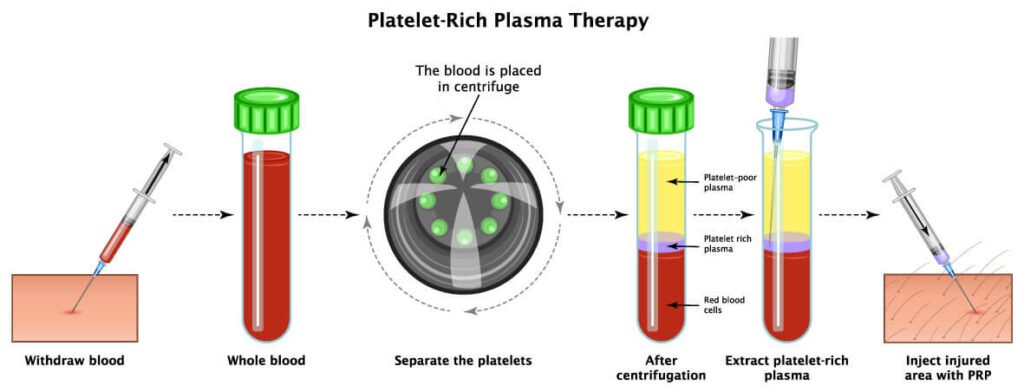
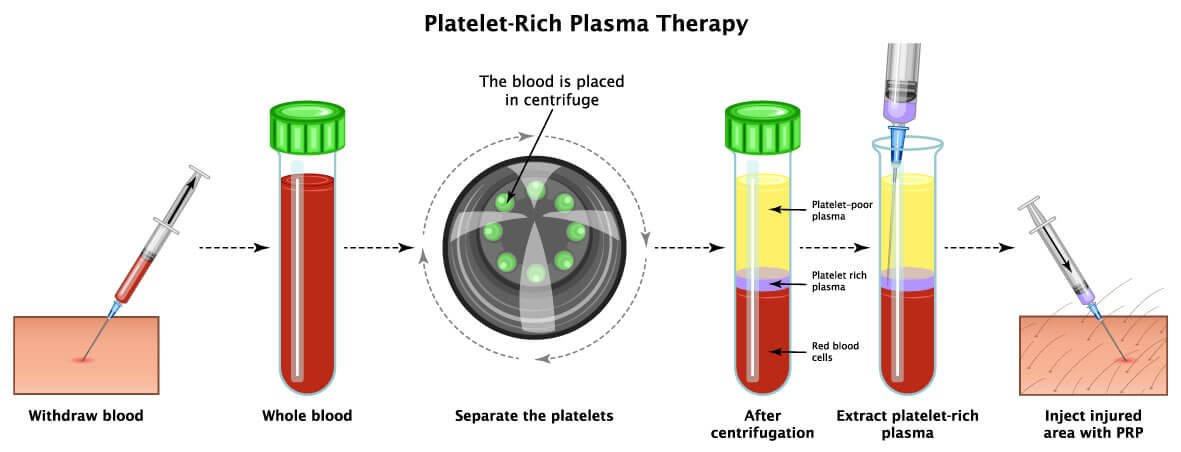
Blood Collection
A small amount of blood — usually around 30–60 ml — is drawn from the patient's arm.
Centrifugation
The blood is spun at high speed in a centrifuge to separate the plasma, platelets, and other components.
Activation
The concentrated PRP is activated using calcium chloride or another agent to release its growth factors.
Administration
The activated PRP is injected directly into the target tissue or applied topically, depending on the treatment area.
Safety & Considerations
PRP therapy is generally considered safe, since it uses the patient's own blood — minimising the risk of rejection or adverse reaction.
As with any medical procedure, potential risks exist — including infection, pain at the injection site, and rare allergic reactions. A full consultation helps determine if PRP is right for you.
Discuss With a SpecialistComplementary Treatments We Offer
PRP is often combined with other non-surgical options as part of a wider recovery plan.
Physiotherapy
Guided exercises and manual therapy to rebuild strength and mobility alongside PRP sessions.
Learn more →Ozone Therapy
A minimally invasive treatment often used alongside PRP for joint and soft-tissue conditions.
Learn more →Disc Problem Care
A non-surgical-first approach for slip disc and herniated disc cases, combining diagnostics with targeted therapy.
Learn more →
Regenerative & Pain Management Team
Our practitioners follow a standardised PRP preparation and administration protocol, tailoring the injection site and technique to each patient's condition.
- Trained in PRP preparation and injection techniques
- Used across orthopedic, joint, and soft-tissue conditions
- Treatment prepared and administered in a controlled clinical setting
- Combined care plans with physiotherapy and ozone therapy where appropriate
Understanding PRP Therapy
Short explainers on how PRP is prepared and what to expect from a session.
▶ Embed your "What Is PRP Therapy?" video here
What Is PRP Therapy?
A simple explanation of how platelet-rich plasma is prepared and used.
▶ Embed your "Inside a Session" video here
Inside a Treatment Session
What to expect on the day of your PRP appointment, start to finish.
▶ Embed your "Is It Right for You?" video here
Is It Right for You?
Who's a good candidate, and questions worth asking before you start.
What Our Patients Say
Real experiences from patients who've had PRP therapy at Global Healthcare India. (Sample layout — replace with verified patient testimonials.)
"Knowing it was my own blood being used made me far more comfortable with the procedure. Recovery was quick too."
"My tennis elbow had lingered for months. A few PRP sessions combined with physio made a real difference."
"The whole process was explained clearly — from blood draw to injection. No pressure, just clear information."
Common Questions About PRP Therapy
Straight answers to what patients usually ask before their first session.
Is PRP therapy painful?
How many sessions will I need?
Is PRP safe, since it's my own blood?
Can PRP be combined with other treatments?
How soon will I see results?
Curious if PRP is right for you?
Talk to our specialists in Pataudi, Gurgaon for an honest assessment of whether PRP fits your condition.