

Quick answer: No, hip replacement does not “cure” avascular necrosis (AVN). It cannot bring dead bone back to life. But it removes the damaged ball of the hip (femoral head) and the worn socket, and puts in a new, artificial joint. Because the dead bone is taken out, the AVN pain in that hip goes away.
If AVN is in a late stage (the ball has collapsed or arthritis has started, ARCO stage III–IV), total hip replacement is the best long-term treatment. If AVN is found early (stage I–II, before the ball collapses), other treatments may save your own hip. This is why getting an MRI early is very important.
What Is Avascular Necrosis (AVN) of the Hip?
Avascular necrosis means “bone dies because it gets no blood.” It is also called osteonecrosis, aseptic necrosis or ischemic bone necrosis.
Your hip is a ball-and-socket joint. The ball is the top of the thigh bone, called the femoral head. The socket is part of the pelvis, called the acetabulum. In hip AVN, the ball does not get enough blood.
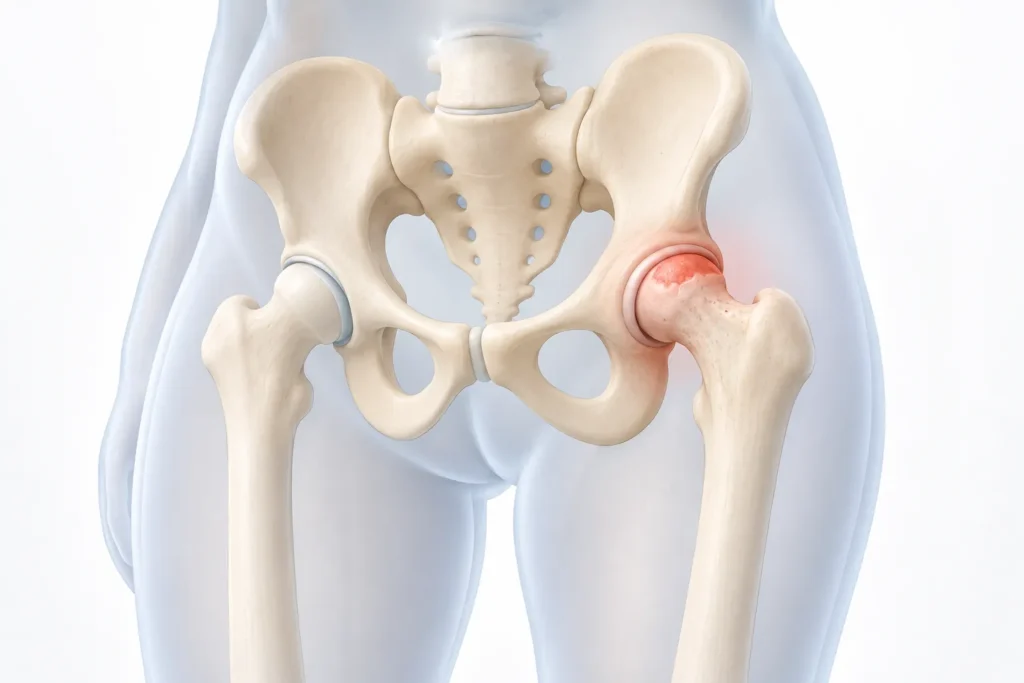
Without blood, the bone cells die. The bone becomes weak and small cracks appear. Slowly, the ball loses its round shape and collapses. Once the ball is not round anymore, the joint wears out and arthritis starts.
The American Academy of Orthopaedic Surgeons (AAOS) says the hip is the joint most often affected. Every year, more than 20,000 people in the US go to hospital for hip AVN, and many of them have it in both hips.
The NCBI StatPearls review also says the hip is the most common place, followed by the knee, the ankle bone (talus) and the shoulder.
AVN usually affects young, working adults between 30 and 50 years old. So choosing between saving the hip and replacing it is a big decision.
What Is AVN Right Hip?
AVN right hip simply means AVN in your right hip. The disease, stages and treatment are the same as in the left hip.
The side makes only a small difference. For example, after right hip surgery, you may need to wait a little longer before you can drive a car.
Symptoms of AVN Right Hip
- Deep, dull pain in the right groin (the most common place)
- Pain that spreads to the right thigh, buttock or even the knee
- Pain when walking, standing or climbing stairs
- Limping and not being able to walk far
- Stiffness, like trouble sitting cross-legged, squatting or putting on socks and shoes
- Pain at night or while resting (in later stages)
In the very early stage, many people feel no pain at all. So if you are at high risk (for example, you have taken steroids), see a doctor as soon as you feel groin pain.
Important: Even if only your right hip hurts, ask for an MRI of both hips. AVN often starts silently in the other hip too, and it is much easier to treat when found early.
Causes and Risk Factors of Hip AVN
| Risk factor | How it harms the hip |
|---|---|
| High-dose or long-term steroids | They raise fat levels in the blood, which blocks the tiny blood vessels in the bone. This is one of the most common causes. |
| Steroids taken for COVID-19 | Many patients in India got AVN a few months after taking steroids for COVID-19. |
| Heavy drinking | Fat builds up in the blood vessels that feed the hip bone. |
| Hip fracture or dislocation | The injury can tear the blood vessels that go to the ball of the hip. |
| Sickle cell disease, Gaucher disease | Abnormal blood cells block blood flow inside the bone. |
| Autoimmune diseases (lupus, rheumatoid arthritis) | Both the disease and the steroids used to treat it raise the risk. |
| Blood clotting problems, radiation, chemotherapy | They reduce blood flow or damage bone cells. |
| Unknown cause (idiopathic) | In many patients, no clear cause is found. |
Stages of Hip AVN (ARCO Classification)
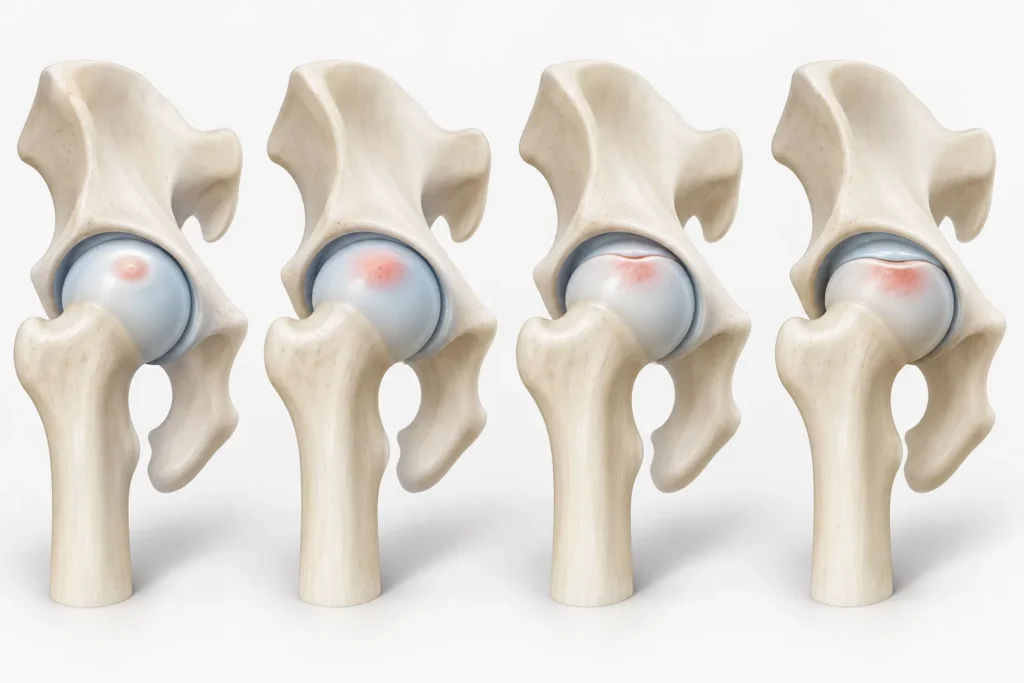
Most doctors today use the ARCO (Association Research Circulation Osseous) staging system to describe how serious AVN is. It is a newer version of the older Ficat and Arlet system. The stage is the most important thing when choosing a treatment.
| ARCO stage | What scans show | Common symptoms | Usual treatment |
|---|---|---|---|
| Stage I | X-ray looks normal, MRI shows AVN | No pain or mild pain | Save the hip |
| Stage II | X-ray shows bone changes, no collapse yet | Mild to moderate pain | Save the hip |
| Stage IIIA | Ball has started to collapse (2 mm or less) | More pain, limping | Save the hip in some young patients, or replace it |
| Stage IIIB | Ball has collapsed more than 2 mm | A lot of pain | Usually hip replacement |
| Stage IV | Joint space is narrow, arthritis has started | Severe pain and stiffness | Total hip replacement |
The size and place of the dead bone also matter. A small dead area on the side of the ball is less serious than a large dead area on the top, where the body’s weight falls.
How AVN Is Diagnosed
- Check-up by a bone specialist. Pain when the doctor turns your hip inward is a common sign.
- X-ray of both hips. It shows AVN from stage II onwards.
- MRI. This is the best test for early AVN. It can find the disease even when the X-ray looks normal.
- CT scan in some cases, to look for a small collapse.
- Blood tests to find the cause (cholesterol, clotting tests, sickle cell test).
Global Healthcare India offers X-rays, blood tests and help with scans through our diagnostic and laboratory services.
Treatment for Avascular Necrosis of the Hip
1. Non-Surgical Treatment (Early Stages)
The goal is to reduce pain, slow down the disease and protect the hip while the ball is still round.
- Removing the cause, like stopping alcohol and avoiding steroids that are not needed. (Never stop prescribed steroids without asking your doctor.)
- Taking weight off the hip by using a walker or crutches
- Pain medicines as your doctor advises
- Bone-protecting medicines (bisphosphonates), blood thinners or cholesterol medicines for some patients. Results are mixed, so doctors decide for each patient.
- Regular physiotherapy to keep the hip moving and the muscles strong. See our physiotherapy and rehabilitation programme.
- Supporting therapies like hyperbaric oxygen, PRP therapy and medical ozone therapy. Some centres use these to help with pain and healing. (Research on these is still going on.)
To learn more, read our guide on 5 ways to treat hip avascular necrosis without surgery.
2. Core Decompression
This is a small, keyhole-type surgery. The surgeon drills one or more thin holes into the ball of the hip. This lowers the pressure inside the bone and helps new blood vessels grow. It works best in stage I–II with small or medium dead areas. It is one of the most common hip-saving surgeries.
3. Core Decompression With Stem Cells (BMAC)
The doctor takes bone marrow from your own hip bone (pelvis), collects the healing cells from it and injects them into the drilled area. Yale Medicine explains that this can help the damaged bone repair itself and stop AVN from getting worse before the ball collapses.
The Mayo Clinic says it may help in early hip AVN, but more research is needed.
4. Bone Grafting
Healthy bone is put in or under the dead area to support the ball of the hip. In some young patients with larger dead areas, surgeons use a piece of the leg bone (fibula) along with its own blood vessels. This is called a vascularised fibular graft.
5. Hip Arthrodiastasis (Joint Distraction)
A frame is fixed outside the leg to gently open up the space in the hip joint. This takes pressure off the ball of the hip, while still letting the joint move. Only a few surgeons do this procedure. It is usually used for carefully chosen, younger patients as part of a plan to save the hip.
At Global Healthcare India, arthrodiastasis may be combined with ozone therapy and physiotherapy for suitable patients.
6. Osteotomy
The surgeon cuts the thigh bone and turns it a little, so that a healthy part of the ball carries the body’s weight. It is a difficult surgery and is used only in some young patients.
7. Total Hip Replacement (Total Hip Arthroplasty)
When the ball has collapsed or arthritis has started, total hip replacement (THR) is the final and most reliable treatment. A 2024 study from Northern India, published in Cureus / PMC, calls hip replacement the gold standard (the best treatment) for late-stage hip AVN.
Does Hip Replacement Cure Avascular Necrosis?
This is the question most patients ask. Here is a clear and honest answer.
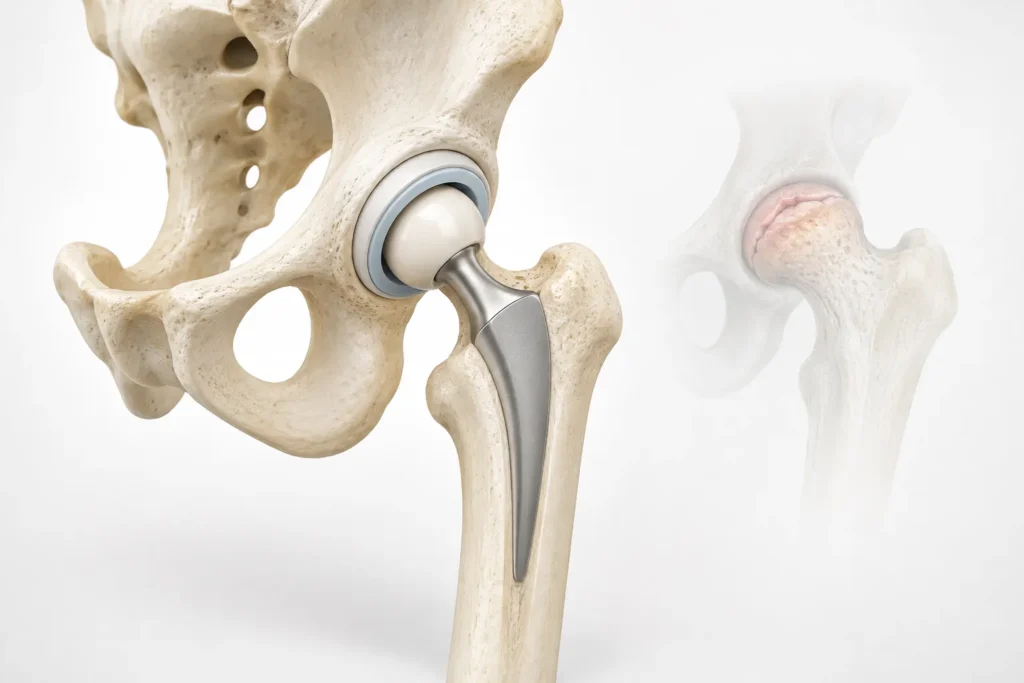
Hip replacement does not cure the disease, but it removes the damaged part. During surgery:
- The dead and collapsed ball of the hip is removed
- The damaged socket is fitted with a metal cup
- A metal stem, a new ball (ceramic or metal) and a smooth liner make a new joint
- Since the dead bone is gone, the AVN pain in that hip stops
What Hip Replacement Does
- Gives strong, long-lasting pain relief
- Helps you walk and do daily work again, and many people can sit cross-legged
- Fixes limping and uneven leg length caused by the collapse
- Lets most people go back to work and normal life
What Hip Replacement Does NOT Do
- It does not remove the cause of AVN (steroids, alcohol, blood disorders)
- It does not protect your other hip, which can still get AVN
- It does not last forever. After many years, the new joint can wear out or become loose, and a second surgery (revision) may be needed. This is more likely in very young and active people.
What the Research Says (Latest Evidence)
- Big improvement in daily life: The Northern India study looked at 111 hip replacements in AVN patients, with an average age of about 37. Their hip function score (Harris Hip Score) went up from about 49 before surgery to about 96 after nearly 5 years. This means their hips went from “poor” to “excellent.” (PMC)
- The type of implant matters: A 2025 study from Japan looked at more than 6,000 hip replacements for AVN. After 10 years, 97% of ceramic joints and 98% of joints with modern strong plastic liners were still working well. Older plastic and metal joints did worse after 20 years. (PMC)
- Young patients need extra care: A 2025 study in The Journal of Arthroplasty looked at AVN patients under 50. Earlier studies showed their results may not be as good as in people with normal arthritis. This is why modern implants and an experienced surgeon are important. (Journal of Arthroplasty)
Bottom line: For late-stage AVN, hip replacement is the surest way to stop the pain and walk normally again. For early AVN, try to save your own hip first, if possible.
Saving the Hip vs Hip Replacement | Which Is Right for You?
| Point | Saving the hip | Total hip replacement |
|---|---|---|
| Best stage | Stage I–II (sometimes early IIIA) | Stage IIIB–IV |
| Goal | Keep your own hip and delay or avoid replacement | Replace the damaged joint |
| Recovery time | Weeks to months of walking with support | Walking in 1–2 days, almost normal by 3 months |
| Pain relief | Varies, depends on the stage | Usually very good and quick |
| Chance of another surgery | May need a hip replacement later if AVN gets worse | May need a revision after many years |
| Best for | Young patients, small dead area, no collapse | Collapse, arthritis, severe pain and disability |
The right choice depends on your age, stage, size of the dead area, condition of both hips, work and lifestyle. Please get a proper check-up from an orthopaedic specialist.
Who Needs Hip Replacement for AVN?
Your surgeon may suggest total hip replacement if you have:
- Collapse of the ball of the hip seen on X-ray or CT scan
- Arthritis in the hip joint
- Severe pain that affects your sleep, work or walking
- A large dead area that is not likely to heal with hip-saving treatment
- No relief after core decompression, bone grafting or other hip-saving treatment
AVN Hip Replacement Cost in India (2026)
Recent 2026 price guides show that one total hip replacement in a private hospital in India costs about ₹2.5 lakh to ₹6 lakh. Replacing both hips costs about ₹4.5 lakh to ₹11 lakh.
Estimated Cost Breakdown
| Procedure | Approximate cost (India, 2026) |
|---|---|
| Core decompression (with or without stem cells) | Much lower than hip replacement; depends on the method |
| One hip replacement (standard implant) | ₹2.5 – ₹4 lakh (smaller cities) |
| One hip replacement (big city / corporate hospital) | ₹3 – ₹6 lakh |
| Premium implants (ceramic-on-ceramic, dual mobility) | Extra ₹0.8 – ₹1.8 lakh (approx.) |
| Robotic hip replacement | Extra ₹0.7 – ₹1.2 lakh (approx.) |
| Both hips replaced in one hospital stay | ₹4.5 – ₹11 lakh |
| Revision (second) hip replacement | ₹5.5 – ₹12 lakh |
These are only estimates. Your final cost will depend on your check-up. Always ask the hospital for a written, detailed estimate.
What Affects the Cost of AVN Hip Replacement?
- Implant brand and material (this makes the biggest difference)
- City and type of hospital (smaller city vs big corporate hospital)
- Room type and number of days in hospital
- Surgeon’s experience and anaesthesia charges
- One hip or both hips
- Other health problems that need extra care (diabetes, sickle cell disease, heart problems)
- Physiotherapy and follow-up visits
Good to Know About Implant Prices
In India, the National Pharmaceutical Pricing Authority (NPPA) has set a maximum price for knee implants. This limit has been extended until November 2026, as reported by Business Standard.
Hip implants do not have this price limit, so their prices can be very different from one hospital to another. Ask your hospital to write the exact implant brand and model in your estimate.
Insurance and Government Schemes
- Most health insurance plans cover hip replacement when it is medically needed. Check the waiting period for joint surgery and get pre-approval from your insurance company.
- Eligible families can get free treatment under Ayushman Bharat PMJAY at listed hospitals. Check if you are eligible on the official PMJAY website.
- CGHS and state government schemes have fixed package rates for their members.
Hip AVN surgery at a well-equipped centre like Global Healthcare India, Pataudi (Gurgaon), often costs less than big-city corporate hospitals, while still using good-quality implants. Contact us for a personal cost estimate.
Recovery After Hip Replacement for AVN
| Time after surgery | What to expect |
|---|---|
| Day 0–1 | Standing and walking with a walker, often on the same day or the next day |
| Day 2–4 | Most patients go home and can climb a few stairs with support |
| Weeks 2–6 | Move from a walker to a walking stick, wound heals, daily exercises |
| Weeks 6–12 | Walking without support, back to desk work, driving when the doctor allows |
| 3–6 months | Almost normal daily life, light exercise like walking, cycling and swimming |
Tips for a Faster, Safer Recovery
- Do your physiotherapy exercises every day. This is the most important part of a good recovery.
- Take blood-thinning medicines as prescribed to prevent blood clots
- Follow the hip safety rules your surgeon gives you (like how to sit and bend)
- Avoid alcohol and control other risk factors to protect your other hip
- Go for your follow-up X-rays so the doctor can check the new joint
You can also read the NHS guide to hip replacement recovery for more tips.
Risks of AVN Hip Replacement
Hip replacement is one of the most successful bone surgeries. But like any surgery, it has some risks:
- Infection in the wound or around the new joint
- Blood clots in the leg (deep vein thrombosis)
- The new joint slipping out of place (dislocation)
- One leg feeling a little longer or shorter
- The implant becoming loose or wearing out over time
- Injury to nerves or blood vessels (rare)
- Risks from anaesthesia
Patients whose AVN is caused by steroids or sickle cell disease may need extra planning before surgery. Choosing an experienced team with ICU and critical care support helps lower these risks.
When Should You See a Doctor?
See a bone specialist soon if you have:
- Pain in the groin, thigh or buttock that lasts more than 2–3 weeks
- A new limp or trouble walking
- Hip pain after taking steroids for a long time (including for COVID-19)
- Hip pain along with heavy drinking, sickle cell disease or a past hip injury
- AVN in one hip already (get the other hip checked too)
The earlier AVN is found, the better the chance of saving your own hip.
AVN Hip Treatment at Global Healthcare India
At Global Healthcare India, Pataudi, Gurgaon, Dr. Sunil Saini and our orthopaedic team treat hip AVN based on its stage:
- Early AVN: Hip-saving care, including hip arthrodiastasis with medical ozone therapy, PRP, medicines and physiotherapy. The aim is to reduce pressure in the joint, improve blood flow to the ball of the hip and protect your natural joint.
- Late AVN: Total hip replacement with modern implants, and physiotherapy in the hospital.
- All care in one place: Tests, surgery, pain management, physiotherapy and 24-hour emergency services.
Our team has treated 15,000+ patients. You can watch real patient recovery stories on our YouTube channel or join our free Hip AVN webinar.
Conclusion
Hip AVN gets worse with time, but it can be treated well if it is found at the right stage. Hip replacement does not reverse AVN. It replaces the damaged joint, and for late-stage AVN it is still the most reliable way to stop the pain and walk normally again. In early stages, hip-saving treatments can help protect your own joint.
If you have groin pain, a limp, or have taken steroids, do not wait for your hip to collapse. Get an MRI and see a specialist early.