

Knee pain is one of the most common health problems in India. Nearly half of elderly Indians live with knee osteoarthritis, and it is no longer only an old-age problem – desk jobs, extra weight and low vitamin D are bringing it to people in their 30s and 40s.
Most articles on Indian home remedies simply list turmeric, mustard oil and methi. This one is different. We tell you which remedies have real research behind them, which are only comforting, and which popular treatments are a waste of your money.
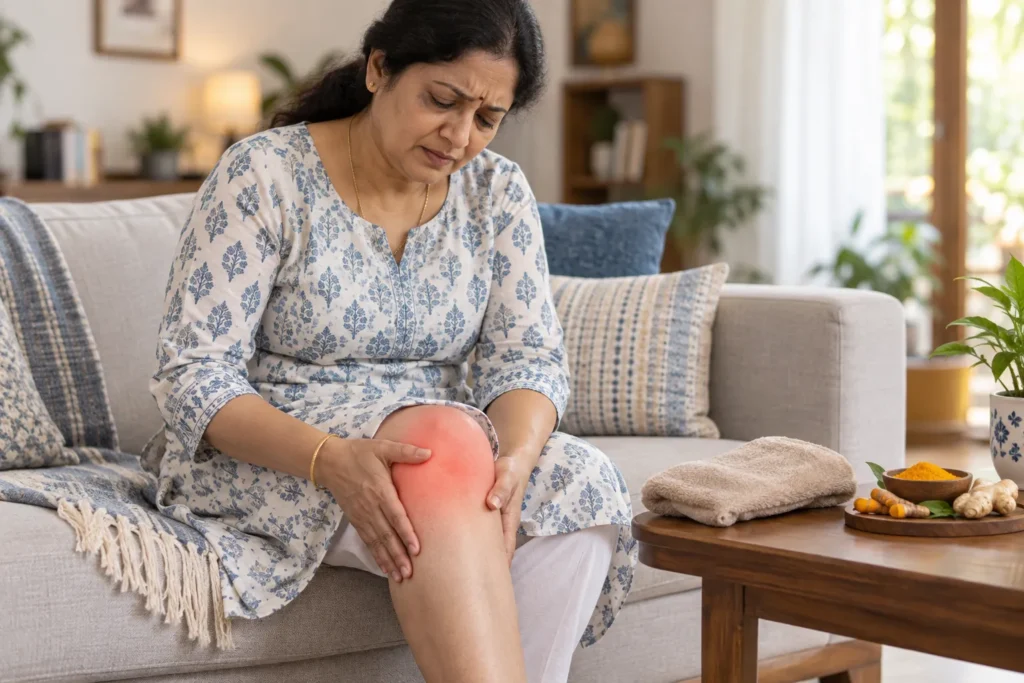
Quick answer: For most knee pain, the two most effective treatments at home are strengthening exercise and weight control. Turmeric has genuine evidence, but the amount in haldi doodh is much smaller than the amount used in studies.
A hot or cold compress helps symptoms. Glucosamine tablets, which many Indians buy, are not recommended by current guidelines.
Let’s go step by step.
How Common Is Knee Pain in India?
The numbers explain why so many families deal with this.
- A 2025 meta-analysis in the Journal of Family Medicine and Primary Care found the pooled prevalence of knee osteoarthritis among elderly Indians was 47% – almost one in two. (PubMed)
- Across the general adult population, a systematic review in the Indian Journal of Orthopaedics estimated knee osteoarthritis prevalence at about 20%. (PubMed)
- Risk is higher in women, in people with lower activity levels, and in those with previous knee injury.
Two habits common in Indian homes add to the load: sitting cross-legged on the floor for long periods, and deep squatting. Both bend the knee far beyond its comfortable range and are repeatedly identified as risk factors in Indian studies.
What Can Cause Knee Pain Without Injury?
You did not fall. You did not twist anything. But your knee still hurts. This is very common, and here is why.
1. Osteoarthritis (the most common reason after 40)
The cartilage cushion between your bones slowly thins. Bones then rub, and the joint becomes painful and stiff.
Typical signs: pain that worsens with walking or stairs, morning stiffness lasting under 30 minutes, swelling, and a grinding or crackling sound.
Learn more on our knee osteoarthritis treatment page.
2. Rheumatoid arthritis
An autoimmune condition where the body attacks its own joints.
Typical signs: both knees affected, warmth and visible swelling, and morning stiffness lasting more than 30 minutes. This needs blood tests and a specialist opinion – it is not something to manage with home remedies alone.
3. Excess body weight
This is the single biggest modifiable cause. Every extra kilogram multiplies the force passing through your knee when you walk, and multiplies it further on stairs.
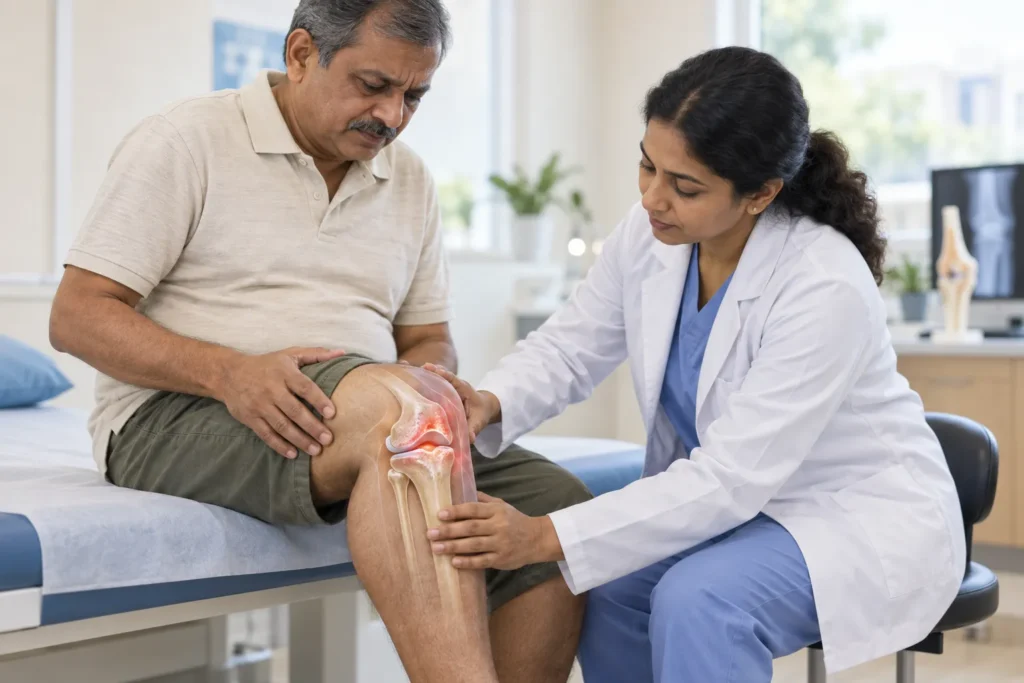
The good news is that the reverse also works. Guidelines note that losing more than 10% of body weight gives the most benefit for knee osteoarthritis – but any amount of weight loss helps.
4. Vitamin D and calcium deficiency
Vitamin D deficiency is remarkably common in India despite our sunshine. An ICMR-funded survey across urban and rural Delhi-NCR found deficiency in a majority of adults, with higher rates among women and people with abdominal obesity.
Low vitamin D causes generalised bone aching and muscle weakness, which can feel like knee pain. A simple blood test settles the question – our diagnostic and laboratory services can check this.
5. Weak thigh muscles
This one gets missed. Your quadriceps muscle acts as a shock absorber for the knee. Long hours of sitting weaken it. Once it weakens, the joint takes more load and starts hurting – with no injury involved at all.
6. Overuse and posture habits
Frequent stair climbing, long squatting during household work, sudden heavy gym routines after months of inactivity, or standing all day on hard floors.
7. Bursitis
The small fluid-filled sacs cushioning the knee become inflamed, causing localised swelling, warmth and pain on bending.
8. Referred pain from the back or hip
Sometimes the knee is not the problem at all. A pinched nerve in the lower back can send pain down the leg. If your pain travels from the back or buttock downward, read about sciatica pain and lower back pain.
Knee Pain Home Remedies – Sorted by Evidence
Here is the honest ranking. We have separated remedies into three levels so you know where to put your effort.
Level 1 – Strong Evidence (do these first)
1. Strengthening exercise
This is not general advice. In international guidelines, therapeutic exercise is the core treatment for knee osteoarthritis — on par with medicine, not an optional extra. Strong thigh muscles reduce the load on the joint itself.
Exercise details are in the section below.
2. Weight management
Even modest, gradual weight loss reduces knee pain and improves function. Combine it with exercise rather than crash dieting. If weight is difficult to control because of thyroid, diabetes or metabolic issues, our metabolic and lifestyle disease care team can help.
3. Topical pain-relief gel
Modern guidelines recommend a topical anti-inflammatory gel as the first medicine to try for knee osteoarthritis, before oral tablets. It works locally with far less risk to the stomach and kidneys than oral painkillers. Ask your doctor or pharmacist which one suits you.
4. Hot and cold compress
Simple, safe and genuinely useful for symptom relief.
- Cold pack when the knee is swollen, warm or recently strained
- Heat when the knee feels stiff, especially in the morning or in winter
- Apply for 15–20 minutes, 2–3 times a day
- Always wrap in a cloth. Never put ice directly on skin.
Level 2 – Reasonable Evidence
5. Turmeric (haldi) – with an important caveat
Turmeric is the one traditional remedy with solid research behind it. A 2025 network meta-analysis in BMC Complementary Medicine and Therapies pooled 17 randomised controlled trials and found that turmeric preparations significantly reduced knee pain scores, with bioavailability-enhanced curcumin extracts performing best. (PubMed)
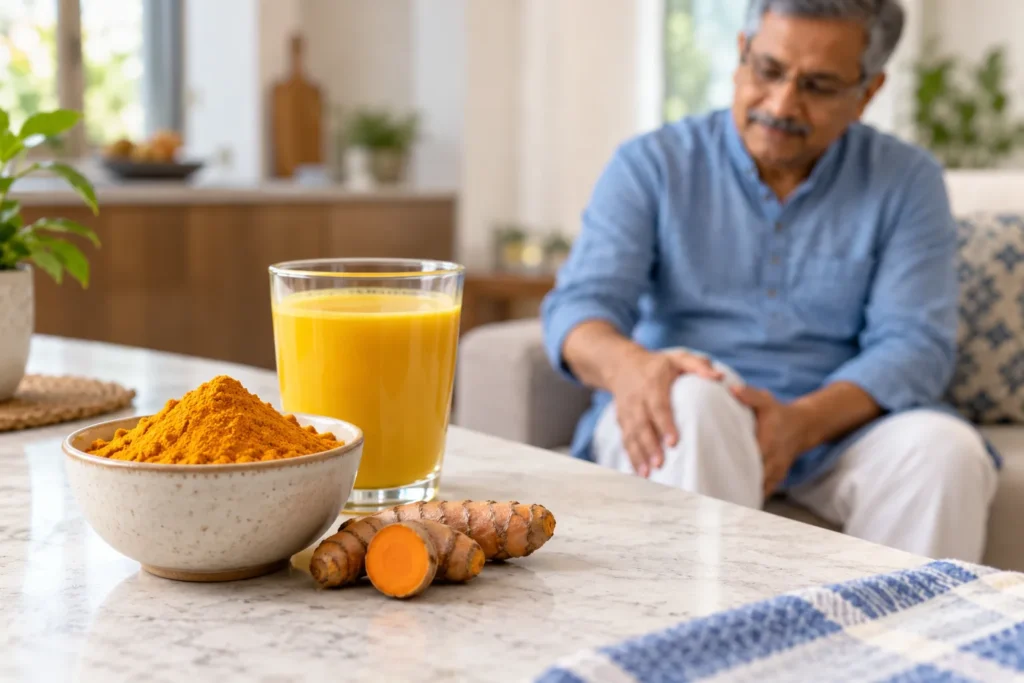
But here is what most articles will not tell you. Those trials used standardised curcumin extracts in specific doses. A teaspoon of household haldi in milk contains only a small fraction of that, and curcumin is poorly absorbed on its own.
So:
- Haldi doodh at night — safe, comforting, mildly helpful. Keep it if you enjoy it.
- Adding black pepper and a little fat (milk, ghee) — genuinely improves absorption.
- A standardised curcumin supplement — closer to what was tested, but talk to your doctor first, especially if you take blood thinners, have gallstones, or are due for surgery.
Turmeric is a helper. It does not replace exercise or weight control.
6. Ginger (adrak)
Modest anti-inflammatory effect in some trials. Ginger tea once or twice daily is safe for most people and worth trying.
Level 3 – Traditional Comfort (safe, but manage expectations)
These are part of Indian households and cause no harm. Just know that the relief is mostly from warmth, massage and relaxation rather than from the ingredient changing your joint.
7. Mustard oil (sarson ka tel) massage — Warm the oil, massage gently for 10 minutes, cover the knee. The improved comfort is real; it comes from the massage and warmth. Test the temperature on your wrist first so you do not burn the skin.
8. Methi (fenugreek) seeds — Soak a teaspoon overnight, eat in the morning. Safe. Evidence for knee pain specifically is limited. Note that methi can lower blood sugar, so diabetics on medication should watch for hypoglycaemia.
9. Epsom salt soak — Relaxing after a long day. There is little evidence that magnesium is absorbed through skin in useful amounts, but warm soaking itself eases stiffness.
What Does NOT Work (Save Your Money)
This section matters as much as the remedies.
| Popular option | Current position |
|---|---|
| Glucosamine supplements | NICE guidance explicitly advises against offering glucosamine for osteoarthritis, stating there is no strong evidence of benefit. Many Indians spend heavily on these. |
| Routine knee caps and braces | Not recommended for routine use. May be useful in specific situations — let a doctor decide, rather than buying one off the shelf. |
| Long-term paracetamol | Guidelines have downgraded paracetamol for osteoarthritis, noting no strong evidence of benefit. It is not a long-term solution. |
| Strong painkillers (opioids) | Not recommended for osteoarthritis. Risks outweigh benefits. |
| Complete rest | The most common mistake. Resting a painful knee for weeks weakens the muscles and makes the pain worse. Modify activity — do not stop moving. |
Source: NICE guideline NG226, Osteoarthritis in over 16s.
Best Exercises for Knee Pain
Start gently. Mild discomfort during exercise is acceptable. Sharp pain is not.
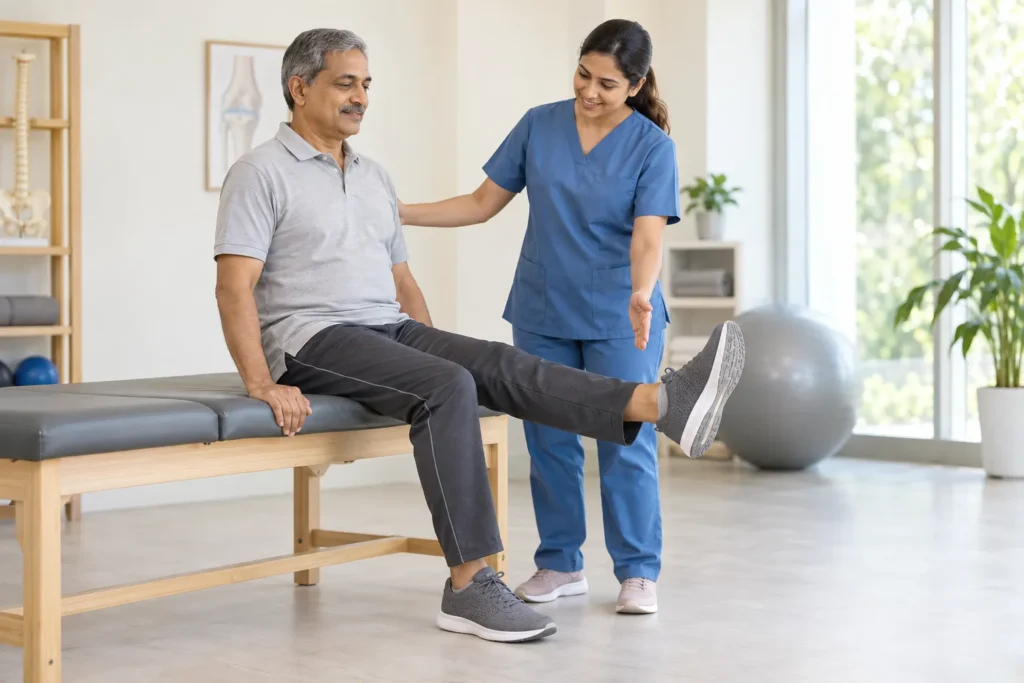
Do these daily:
- Straight leg raise — Lie on your back, one knee bent, other leg straight. Lift the straight leg about 30 cm, hold 5 seconds, lower slowly. 10 repetitions, 2 sets, each leg.
- Quadriceps setting — Sit with the leg straight. Press the back of the knee down into the floor, tightening the thigh. Hold 5 seconds. 10 repetitions.
- Seated knee extension — Sit on a chair, slowly straighten one knee, hold 3 seconds, lower. 10 repetitions each leg.
- Hamstring stretch — Hold 20–30 seconds each leg. No bouncing.
- Calf raises — Hold a chair for balance, rise onto toes. 10 repetitions.
Good low-impact activity: walking on flat ground, stationary cycling with low resistance, swimming.
Avoid for now: deep squats, running on concrete, jumping, and long periods of sitting cross-legged on the floor.
Doing these correctly matters more than doing them often. Our physiotherapy and rehabilitation team can build a programme around your specific knee.
Small Changes for Indian Homes
Practical adjustments that reduce daily knee load:
- Use a Western toilet if available, or install a grab bar beside an Indian toilet. Deep squatting is one of the hardest positions for an arthritic knee.
- Sit on a chair for meals and prayer instead of the floor, or use a low stool if floor seating is important to you.
- Keep daily-use items at waist height in the kitchen to reduce repeated bending.
- Take stairs one step at a time, leading with the stronger leg going up and the weaker leg going down.
- Wear cushioned footwear at home. Hard tile floors are unforgiving. Avoid completely flat, thin chappals for long standing.
- Get 15–20 minutes of morning sunlight on arms and legs for vitamin D.
- Do not sit still for more than 45 minutes. Stand and move for two minutes. This one habit helps more than most supplements.
Red Flags – See a Doctor Immediately
Home remedies are for mild, gradual knee pain. Go to a hospital the same day if you have:
- A knee that is hot, red and swollen along with fever – this can be a joint infection and is a medical emergency
- Inability to bear weight on the leg
- A knee that locks or gives way suddenly
- Sudden severe swelling within hours of an injury
- Calf pain and swelling with redness — this needs a clot ruled out
- Obvious deformity after a fall
- Numbness or weakness in the foot
Book a routine appointment if:
- Pain lasts more than 2–3 weeks despite home care
- Morning stiffness regularly exceeds 30 minutes
- Both knees are affected together
- Pain wakes you at night
- You are already avoiding stairs, walks or daily activities
Our hospital in Pataudi, Gurgaon runs a 24-hour emergency service. Book an appointment or call +91-9996888124.
Medical Treatment Options
If home care is not enough, treatment is stepwise — surgery is genuinely the last option, not the first.
- Accurate diagnosis — clinical examination, and X-ray or blood tests where needed
- Structured physiotherapy — supervised strengthening, the backbone of non-surgical care
- Correcting deficiencies — vitamin D and calcium, if blood tests confirm a shortfall
- Topical and oral medicines — prescribed with attention to stomach, kidney and heart risk
- Non-surgical interventions — including PRP therapy and ozone therapy for selected patients
- Steroid injection — useful for flare-ups, but relief is temporary
- Arthroscopic surgery — for specific mechanical problems such as a torn meniscus
- Knee replacement — considered only when pain substantially affects quality of life and non-surgical options have been exhausted
Explore our full orthopaedics and complex trauma services.
The Bottom Line
Knee pain is common in India, but “common” does not mean you should accept it silently.
Do these three things first: strengthen your thigh muscles, manage your weight, and keep moving within comfortable limits. Add turmeric, ginger and warm compresses if they help you. Skip the glucosamine.
And if the pain has lasted more than two weeks, or your knee is swollen, hot or unstable, get it examined. Early treatment protects the joint. Waiting rarely does.
Consult our orthopaedic specialists in Pataudi, Gurgaon. Book an appointment or call +91-9996888124 — emergency services available 24 hours.
Medical disclaimer: This article is for general information and does not replace a consultation with a qualified doctor. Knee pain has many possible causes, and treatment must be based on individual examination. Do not start or stop any medicine or supplement without medical advice.
Frequently Asked Questions
Q. What is the best home remedy for knee pain in India?
The most effective home treatments are daily quadriceps strengthening exercise and weight control. For symptom relief, a hot or cold compress works well. Among traditional remedies, turmeric has the strongest research support, though household haldi doodh contains far less curcumin than the doses used in clinical trials.
Q. Can knee pain go away without medicine?
Yes, mild knee pain often improves with exercise, weight management, activity modification and hot or cold compresses. If pain persists beyond two to three weeks, or you have swelling, fever or difficulty walking, see a doctor rather than continuing home treatment.
Q. Is haldi doodh really good for knee pain?
Turmeric contains curcumin, which has anti-inflammatory effects, and pooled trial data shows turmeric preparations reduce knee pain scores. However, trials used concentrated, standardised extracts. Haldi doodh is safe and mildly helpful, but should be seen as a supportive habit rather than a treatment on its own.
Q. Why do my knees pain without any injury?
The most common reasons are osteoarthritis, excess body weight, weak thigh muscles from prolonged sitting, vitamin D deficiency, rheumatoid arthritis, bursitis, and overuse from squatting or stair climbing. Pain can also be referred from a problem in the lower back or hip.
Q. Should I take glucosamine tablets for knee pain?
Current NICE guidance advises against glucosamine for osteoarthritis, noting no strong evidence of benefit. Discuss any supplement with your doctor before spending on long-term courses.
Q. Is walking good or bad for knee pain?
Walking on flat ground is generally good and helps maintain joint health and muscle strength. Avoid steep slopes, uneven ground and long stair climbs during a flare-up. Complete rest is not advisable, as it weakens the muscles that protect the knee.
Q. At what age does knee pain usually start in India?
Osteoarthritis is most common after 40 and rises steeply in older adults, with roughly half of elderly Indians affected. However, knee pain from weak muscles, vitamin D deficiency or overuse is increasingly seen in people in their 20s and 30s with desk-based jobs.
Q. Does cracking sound in the knee mean arthritis?
Not necessarily. Painless clicking or crackling is common and often harmless. It becomes significant when accompanied by pain, swelling, stiffness or a feeling that the knee is catching or giving way.