
Quick Answer
Endoscopic spine surgery is not a better operation than open surgery, but for the right problem it gives you a faster early recovery. For a single slipped disc in the lower back, a five-year randomised trial found no real difference in results between the two. The endoscopic route means a smaller cut, less damage to the back muscles and a shorter hospital stay. It is not proven to be safer, it does not suit every spine problem, and your result depends a lot on the surgeon’s experience.
If you have been told you need spine surgery, you have probably read about smaller cuts, less pain and a quicker return to work. Most of that is true. But very few pages tell you what the research actually found, how often things go wrong, or the one thing that affects your result more than the technique itself. This page explains all of it in plain words.
What Is Endoscopic Spine Surgery?
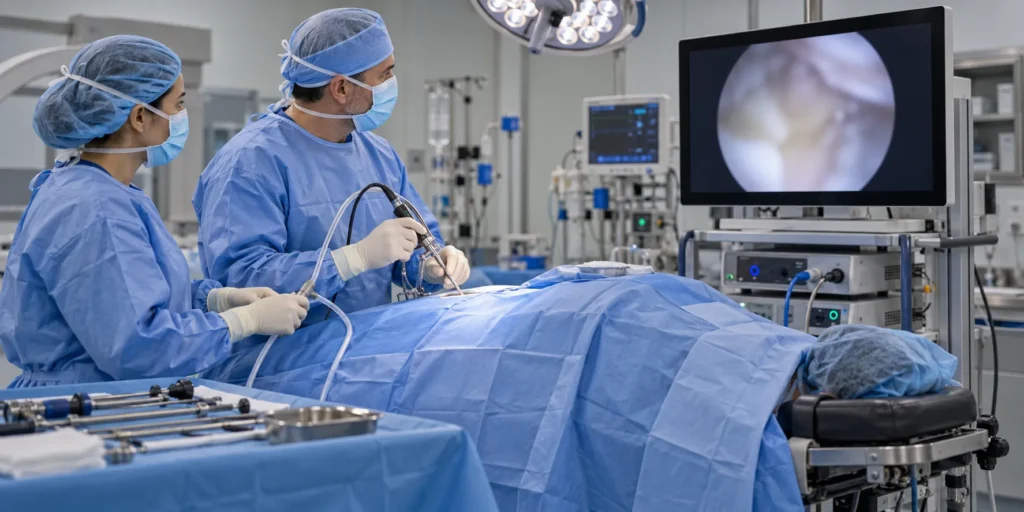
Endoscopic spine surgery is a minimally invasive operation done through a very small cut, usually less than 1 cm. The surgeon passes a thin tube with a camera and a light on the end into your back, then works while watching a screen. Fluid flows through the tube the whole time to keep the view clear.

In open surgery, the surgeon makes a longer cut and moves the back muscles aside to see the spine directly.
The main difference is the way in, not the repair. In both types, the surgeon removes whatever is pressing on a nerve. Most often, this is part of a slipped (herniated) disc.
Uniportal vs Biportal Endoscopic Surgery
There are two main ways to do endoscopic spine surgery:
- Uniportal: One tube is used. The camera and the surgical tools share the same channel.
- Biportal: Two small cuts are made, one for the camera and one for the tools. This gives the surgeon more room to work, and it is often said to be easier to learn.
Ask your hospital which type they use.
Is Endoscopic Surgery the Same as Minimally Invasive Spine Surgery?
Not quite. Minimally invasive spine surgery covers several techniques, including tubular and microscope-assisted surgery through cuts of a few centimetres. Endoscopic surgery is the smallest of these.
If a hospital says your operation is “minimally invasive”, ask exactly which technique they mean.
Endoscopic vs Open Spine Surgery: Side-by-Side Comparison
| Feature | Endoscopic surgery | Open or microendoscopic surgery |
|---|---|---|
| Size of cut | Usually under 1 cm | Longer |
| Damage to back muscles | Less | More |
| Time in bed after surgery | Shorter | Longer |
| Hospital stay | Shorter | Longer |
| Complication rate | 1.5% (median) | 1.0% (median), no significant difference |
| Results at five years | No significant difference | No significant difference |
| Disc slipped again (five-year trial) | 7 patients | 7 patients |
| Suitable for fusion, deformity or problems at many levels | Usually not | Yes |
| How much surgeon experience matters | A lot. One study found steady skill at about 51 cases | Widely taught for decades |
Note: Complication rates compare endoscopic surgery with open microdiscectomy (NICE review). Five-year results and repeat disc problems compare endoscopic surgery with microendoscopic discectomy (Spine trial).
What this table shows: Endoscopic surgery wins on early recovery. On the rows that show whether the operation actually worked, it is a tie.
Does Endoscopic Spine Surgery Work as Well as Open Surgery?
Yes, for a single slipped disc in the lower back. The best available trial found no meaningful difference in results over five years.
This randomised controlled trial, published in the journal Spine, followed 241 patients. Of these, 119 had percutaneous transforaminal endoscopic discectomy (PTED) and 122 had microendoscopic discectomy (MED).
In total, 194 patients were followed for the full five years. The researchers found no significant difference between the two groups in any main or secondary result at any check-up. Seven patients in each group had their disc slip again.
This finding matters in two ways:
- It shows endoscopic surgery is a real treatment option, not a marketing trick.
- It also means you should be careful with anyone who sells it as a better operation. Over five years, it was an equally good one.
The UK’s National Institute for Health and Care Excellence (NICE) reviewed the same evidence. In its guidance on endoscopic lumbar discectomy for sciatica, NICE said the procedure is “safe enough and works well enough for use in the NHS.” That is careful wording, and it is the right level of confidence to have.
Is Endoscopic Spine Surgery Safer Than Open Surgery?
Not measurably. This is where many websites overstate the case.
NICE’s safety review looked at six studies covering 1,302 patients. It found no significant difference in median complication rates: 1.5% for endoscopic surgery and 1.0% for open microdiscectomy.
So any page that says endoscopic surgery has “fewer complications” is making a claim the evidence does not support. A smaller cut does not automatically mean a safer operation. It means less damage to the muscles, which is a real benefit, but a different one.
So What Do You Actually Gain?
Less disturbance to your back muscles and a faster early recovery. In the five-year trial, the endoscopic group spent less time in bed after surgery and less time in hospital. That is a real, measured advantage. It is just not the same as a safer or more effective operation.
Endoscopic Spine Surgery Risks and Complications
Here are the numbers most patient websites leave out. All figures come from NICE’s evidence review of transforaminal endoscopic lumbar discectomy.
| Complication | What it means | How often it was reported |
|---|---|---|
| Overall complications | Any problem linked to the surgery | 2.8% (median across 28 studies, 6,336 patients) |
| Dural tear | A leak from the thin covering around the nerves | 1.1% (9 of 816 patients) |
| Pseudocyst | A fluid-filled pocket that forms near the spine | 1% (15 of 1,503 procedures) |
| Retroperitoneal haematoma | Bleeding behind the belly area | 1% (4 of 412 patients) |
| Spondylodiscitis | Infection of the disc and nearby bone | Under 1% (12 of 9,821 patients) |
NICE also noted that most complications were short-term changes in feeling, such as tingling, burning or numbness, usually in the leg.
Can the Disc Slip Again After Surgery?
Yes. In the five-year trial, seven patients in each group had a recurrence. Surgery removes the piece of disc pressing on your nerve. It does not make the disc new again.
Can Endoscopic Surgery Be Switched to Open Surgery?
Yes. If the surgeon cannot see clearly, or cannot reach the disc piece safely through the tube, the right decision is to switch to open surgery during the operation. This is not a failure.
It is good judgement. But your surgeon should tell you about this possibility before the operation, and most websites never mention it.
Who Is a Good Candidate for Endoscopic Spine Surgery?
Endoscopic surgery is usually considered for:
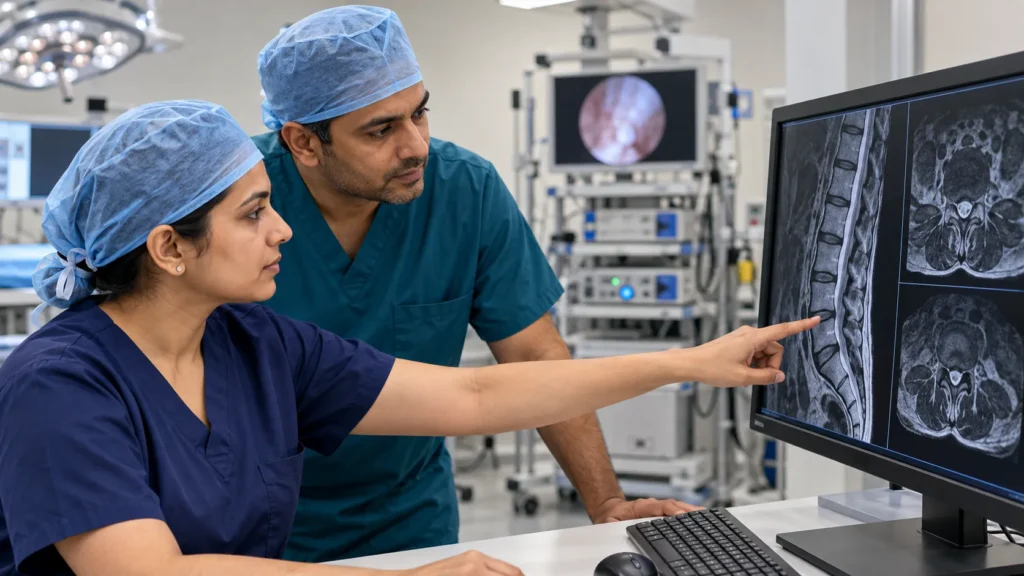
- A slipped disc at one level of the spine that is pressing on a nerve
- Leg pain or sciatica caused by a pinched nerve
- Mild to moderate narrowing of the space where the nerve leaves the spine (foraminal stenosis)
- Symptoms that have not improved with proper non-surgical treatment
Who Is Not a Good Candidate?
Endoscopic surgery is usually not the right choice for:
- An unstable spine, or any problem that needs spinal fusion
- Severe spinal stenosis, or narrowing at several levels
- Scoliosis or other major spine deformity
- Tumours, infections or major fractures
- Some hardened (calcified) disc pieces, or pieces that have moved far from the disc, because they can be hard to reach through a narrow tube
What If My Pain Is Mostly in My Back, Not My Leg?
Ask your surgeon about this directly. Operations that free a pinched nerve, whether endoscopic or open, are meant to treat nerve pressure. Nerve pressure usually causes leg pain.
Back pain on its own has many other causes and often does not respond as well to this kind of surgery. A good surgeon will explain this difference clearly.
Can I Have Endoscopic Surgery If I Have Had Spine Surgery Before?
Sometimes. Scar tissue from an earlier operation changes the anatomy and makes the approach harder. In this case, the surgeon’s experience matters even more than usual. Ask how many revision spine surgeries they have done.
Why Your Surgeon Matters More Than the Technique
This is the part that should change how you choose.
Endoscopic spine surgery is known to have a steep learning curve. A 2025 study in the Journal of Orthopaedic Surgery and Research looked at one surgeon’s first 60 endoscopic decompression operations.
Using a method called cumulative summation (CUSUM) analysis, it found the surgeon reached a steady level of skill after 51 cases. The same study noted that surgeons already skilled in microscope spine surgery could still do the procedure safely while learning.
NICE makes the same point. It says this procedure should only be done by surgeons with specific training and expertise. Surgeons who are new to it should first work alongside an experienced surgeon who does it regularly.
In simple words: your result depends more on who is holding the endoscope than on the fact that an endoscope is used.
Many websites that promote a named surgeon never mention the learning curve at all. Yet it is one of the most useful facts a patient can know.
How Do I Ask My Surgeon About Their Experience Without Offending Them?
Just ask plainly:
- “How many of these operations have you done?”
- “How many have you done for my specific problem?”
- “How often do you have to switch to open surgery?”
A surgeon who is confident in their numbers will answer without hesitation. If they hesitate, that tells you something too.
Endoscopic Spine Surgery Recovery: What to Expect
Here is something most websites do not admit: published recovery times for this surgery do not agree with each other, and most give no source.

One says you can go back to desk work in 1 to 2 weeks. Another says 2 to 3 weeks. One says full recovery takes 4 to 6 weeks, while others put open-surgery recovery at 6 to 12 weeks, or even 3 to 6 months.
They cannot all be right. That is because recovery does not depend only on the operation. It also depends on:
- Which level of the spine was treated
- How long the nerve was pinched before surgery
- Your age and general health
- Whether you smoke
- How physical your job is
- How well you follow your rehabilitation plan
What the evidence does show: in the five-year trial, the endoscopic group spent less time in bed and had a shorter hospital stay than the comparison group. Many patients are walking on the same day.
For anything beyond that, ask your own surgeon for a timeline based on your scan and your job. A number from a website, including this one, is not a prediction about you.
Will I Need Physiotherapy After Endoscopic Spine Surgery?
Almost certainly, and it matters. Surgery takes the pressure off the nerve. It does not bring back the strength and movement you lost while you were in pain. Ask about the rehabilitation plan before you agree to surgery, not after.
Staying active and eating well also helps your body heal. For simple everyday fitness and wellness tips, you can visit ZeroMedix.
Will I Be Awake During Endoscopic Spine Surgery?
It depends. Some endoscopic procedures can be done under local anaesthesia with sedation, which means you are awake but comfortable. Others are done under general anaesthesia, where you are fully asleep. The choice depends on the procedure, the part of the spine being treated and your health.
Being awake has one real benefit: you can tell the surgeon if you feel a nerve being touched. But it is not right for everyone. Ask which type is planned for you, and why.
How Much Does Endoscopic Spine Surgery Cost?
We do not list a price on this page, because the honest answer is that it depends. The cost changes with the spine level, the technique, any implants, how long you stay in hospital and your insurance. Two things are worth knowing before you compare quotes:
- The upfront cost can be higher because the equipment is expensive. But the total cost can end up similar or lower if you spend less time in hospital and less time off work. Compare the whole treatment, not just the surgeon’s fee.
- Check your insurance first. Ask your insurer directly whether the exact procedure code is covered. Cover for endoscopic spine surgery is not the same everywhere, and finding out afterwards is an expensive way to learn.
When to Get Urgent Medical Help
Whether or not you have had surgery, some symptoms need a same-day medical check. Do not wait for an appointment if you notice:
- Loss of bladder or bowel control, or trouble passing urine
- Numbness around the groin, genitals or inner thighs (the area a saddle would touch)
- Weakness in both legs, or weakness in one leg that is quickly getting worse
- Fever with severe back pain, especially after a procedure
- Clear fluid leaking from the wound, or a severe headache that gets much worse when you sit or stand up
These can be signs of serious problems, including cauda equina syndrome, which needs emergency treatment.
Questions to Ask Before You Agree to Spine Surgery
- What exactly is pressing on which nerve, and can you show me on my scan?
- Is my main problem leg pain or back pain, and which one is this surgery meant to fix?
- What happens if I wait three more months and continue non-surgical treatment?
- How many of these operations have you done, and how many for my exact problem?
- How often do you switch to open surgery, and what would make you do that?
- What is the realistic chance I will need a second operation?
- What does rehabilitation involve, and who provides it?
Should I Get a Second Opinion Before Spine Surgery?
For any planned spine operation, yes. A surgeon you can trust will not mind. A second opinion costs you a consultation fee and some time. An unnecessary operation costs much more. If you would like one, you can book a spine surgery second opinion with our team.
Conclusion – Is Endoscopic Spine Surgery Right for You?
Endoscopic spine surgery is a real advance. For the right problem, in the right hands, it offers a noticeably gentler early recovery than open surgery.
But it is not a better operation. Based on the evidence we have, it is not a safer operation either. It does not suit every spine problem, and it depends heavily on the surgeon’s experience.
Anyone who tells you otherwise is selling, not explaining.
Key Takeaways
- For a single slipped disc in the lower back, a five-year randomised trial found no significant difference in results between endoscopic and microendoscopic surgery at any check-up.
- NICE found no significant difference in complication rates: 1.5% for endoscopic surgery and 1.0% for open microdiscectomy. Endoscopic surgery is not proven to be safer.
- The proven benefit is a faster early recovery, with less time in bed and a shorter hospital stay.
- Overall complications are about 2.8%. Dural tears happen in about 1.1% of patients, and disc infection in under 1%.
- The disc can slip again. Seven patients in each group had a recurrence in the five-year trial.
- The operation may be switched to open surgery if the view or the disc piece makes that the safer choice.
- The surgeon matters more than the technique. One study found steady skill after about 51 cases, and NICE requires specialised training.
Frequently Asked Questions About Endoscopic Spine Surgery
Q. Is endoscopic spine surgery better than open surgery?
For a single slipped disc in the lower back, a five-year randomised trial found no significant difference in results. Endoscopic surgery gives a faster early recovery, not a better long-term result.
Q. Is endoscopic spine surgery safe?
NICE says it is “safe enough and works well enough for use in the NHS.” The overall complication rate is about 2.8%, and NICE found no significant difference compared with open microdiscectomy (1.5% vs 1.0%).
Q. How long does recovery take after endoscopic spine surgery?
Published timelines vary a lot, and most give no source. Trial evidence shows less time in bed and a shorter hospital stay than the comparison surgery. Your own recovery depends on the spine level treated, your age, your health and your job, so ask your surgeon for a timeline based on your scan.
Q. Can endoscopic spine surgery be done under local anaesthesia?
Yes, in some cases. It can be done under local anaesthesia with sedation or under general anaesthesia, depending on the procedure, the spine level and your health. Ask which is planned for you and why.
Q. What happens if the surgeon cannot finish the operation endoscopically?
The surgeon can switch to open surgery during the operation if the view is not clear or the disc piece cannot be reached safely. This is a decision made in your favour, not a complication, but you should be told about it before surgery.
Q. Can the disc slip again after endoscopic spine surgery?
Yes. In the five-year randomised trial, seven patients in each group had a recurrence. Surgery removes the piece pressing on the nerve. It does not make the disc new again.
Q. How many procedures should my surgeon have done?
One published study found a surgeon reached a steady level of skill after about 51 cases. NICE says surgeons need specific training and should work alongside an experienced surgeon when starting out. Ask your surgeon for their numbers directly.
Sources
- Chen Z, et al. Percutaneous Transforaminal Endoscopic Discectomy Versus Microendoscopic Discectomy for Lumbar Disk Herniation: Five-year Results of a Randomized Controlled Trial. Spine, 2023;48(2):79–88.
- NICE. Percutaneous transforaminal endoscopic lumbar discectomy for sciatica (first published April 2016 as IPG556).
- NICE. Interventional procedure overview of percutaneous transforaminal endoscopic lumbar discectomy for sciatica.
- Park SC, et al. Learning curve for full-endoscopic lumbar decompression via interlaminar approach using the learning curve cumulative summation analysis. Journal of Orthopaedic Surgery and Research, 2025;20:297.